Exhaust Header Tube Sizing and Length
There is a variety of data available on how to select a set of headers for your application. We are going to provide you a simplified explanation here. Headers and exhaust system modifications are the best improvement per dollar of any bolt-on modification which you can do to your vehicle. To put all the magazine articles, manufacturer and dealer recommendations into perspective, you have three primary concerns:
- The size of the tubes meets the requirements of the engine.
- The length of the header tubes and collector size meets the use of the vehicle.
- The headers actually fit your vehicle without having to use a sawzall, cutting torch, or sledge hammer to persuade them.
This article will help explain the choices available and how to select the correct header for your application. You will also find other information that has been misrepresented in other publications. We will do our best to make our presentation of facts simple and precise.
Primary Tube Size
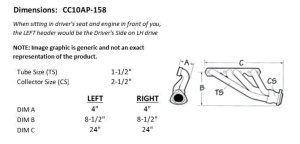
The primary tube size is the OUTSIDE diameter of the header tubes. Common primary tube sizes are 1-1/2", 1-5/8", 1-3/4", 1-7/8", 2", 2-1/8", 2-1/4", & 2-3/8".
When you are considering primary tube size you are going to base it upon the engine size, horsepower output, use of the vehicle, and if any other power-adders (nitrous or supercharger) are being used. The smaller tubes keep the air velocity up for more torque, where the larger tube size is better for upper RPM performance. If your headers are too small for the application they will cause restriction and increase heat in the engine. Too large a header will reduce torque output of the engine and increase the possibility of exhaust gas reversion. Simply put, you can relate torque to air velocity, and horsepower to the volume of air flow. The faster the air enters and exists your engine the more torque you make, and the more volume of air you get through the engine, the more horsepower the engine will produce. You want a balance of both in your selection.
Example: If you have a stock engine up to about 350 cubic inches, and producing about 300 horsepower installed in your street rod that is going to spend most of it's time going stop light to stop light, all you need is a 1-1/2" primary tube size header. Now, add a supercharger to the same and you need a 1-5/8" to 1-3/4" header.
Most header manufacturers are dead accurate with their header sizes when they are for specific vehicle applications. This holds true for all of the smog-legal direct fit headers for new model vehicles. These manufacturers, such as JBA and Gibson, have already completed the research and development work for you to make sure that you are provided a header that matches your vehicle perfectly. Where you run into selection questions begins with universal or custom fabricated headers.
The dyno chart below shows a basic difference between a small tube and large tube header set. This engine was tested with both small and large tube headers. If this was your engine and a majority of the driving was done at low engine speeds, the small tube design would be your best choice. Bigger is not always better.
As with the street rod example above, a small tube header is perfect, and the primary tube size would increase with engine size and horsepower output. If you changed the engine to a mild 396-454" big block Chevrolet, a 1-5/8" to 1-3/4" header is needed. Again, engines size, power output, and intended use decide primary tube size.
For racing applications there is specific data required to select the right header set. Engine size, operating RPM range, horsepower output, type of racing (drag, circle track, road racing, monster truck, tractor pulls, sprints, hill climb, and more), and single or multi-step design. Further down in this article we have provided specs for a properly configured header using modern calculation software. The software takes all of these parameters into consideration to present a header design that is matched specifically to your engine. Then, all you have to do is purchase a set that is "close", or have a set custom made that fits your vehicle.
Primary Tube Length
We will jump right in to this topic with the debate over SHORTY versus LONG TUBE, and Equal Length headers.
We sell both styles, and both have their benefits and disadvantages. But, for those that start bad-mouthing either design without all the facts is severely limiting their options and knowledge of facts.
Shorty Headers
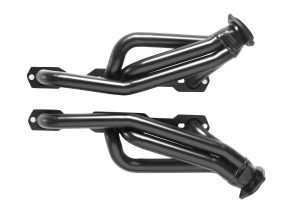
PROS- Easy installation, variety of sizes available for popular applications, improved ground clearance, designed for space-limited installations, definite improvement over factory manifolds, inexpensive
CONS - Slight loss of torque in high power/high RPM applications, it is sometimes possible for the shorter design to be strained at the collector on high power applications
Full-Length Headers (Equal Length Primary)
PROS - Best for racing and high performance, improved torque in some applications, best for maximum power, more variety of sizes and lengths available to match specific needs
CONS - Installation is more difficult, less clearance everywhere, having to make modifications is common, mini-starter required in many applications, expensive
The biggest complaint (or concern) we hear from our customers is that they are worried that a shorty header is not going to make as much power as a full length header. That is fact, but what they miss is that in most cases if they are looking at a shorty header in the first place it is NOT all about horsepower. If they are not racing the vehicle they are working on, and they have issues with clearances or even getting a header to fit at all, and they are worried about the expense of either the full length or having to pay for someone to build a custom set, a shorty header is the answer. If you look at the graph below, you will see that there really is not much loss of power with a shorty header, and in this particular engine the short tube header makes more power at lower operating RPMs.
Of course, if the vehicle is a racing or performance application where maximum power is of primary concern, we are going to tell you that your best choice is a full length header.
Collector Size
Collector size is measured in both length and diameter. In a shorty, street rod type application the collector length is of no concern. In these headers the collector is merely a union point for the primary tubes, and a connection point for your exhaust system. The collector diameter is important in that you need a diameter compatible with both the power output of the engine, and the tubing size for the rest of your exhaust system. Of course you can always use a reducer to meet the size of a smaller exhaust system, but with a shorty or mid-length header the collector is typically of a standard size combination for that header and the engine it fits. With a full length header you will typically find that the collectors are fairly large in all but those designed for trucks, SUVs and motorhomes. This is due to the fact that most full length header is designed for max power, and upper RPM use. In racing applications you can use the collector length to slightly tune the torque output of the engine.
As with what we have stated above, collector length and diameter selection are controlled by the engine size, power output, and operating RPM. Too large and you slow down the exhaust gas velocity, and too small adds heat and flow restriction.
Step-Header Designs
Most of you that are reading this article may never have heard of a step-header. This is because step-headers are used almost exclusively in race-only application. A step-header design is that which has more than one size of primary tubing. You start with a smaller header tube diameter and have one or two larger sizes which begin at various distances from the flange and last step. Where the steps (increases in tube diameter) are placed depends on the engine size and operating RPM.
You will find a few websites that bad-mouth step-header designs as a waste of money. They claim that they do not work, the theory is bad, etc. You have to decide why these people are condemning this design. Are they selling something different? Well, if the step-header designs were as crappy as these sites describe, heavily funded race teams would NOT be using them on championship winning engines. It is this writer's opinion that there are uses and benefits from step-headers, but not every engine is going to show gains.
A step-header is built by starting with a slightly smaller tube, then going up in size in one more (2-step), or two more (3-step) sizes. If you look at the exhaust port of your cylinder heads you will notice that they typically are NOT of the same size as your header tubes. You won't even find a header flange that is a direct match in dimension to your exhaust port unless it is a race only application that has been user/builder modified, or someone looking to spend the time and expense to fine every available horsepower. If the exhaust ports on your cylinder heads get too big you lose air velocity and torque, and take the chance of increasing the possibility reversion. As the exiting exhaust gases travel through the headers they are expanding until they cool enough to where expansion stops. The longer you can keep the exhaust velocity up, the better the scavenging of the cylinders, and the more power and torque the engine can make.
By starting with a slightly smaller tube, the exhaust velocity stays up. As the gases expand, it hits the next size step. This allows for contained control of the expansion while still keeping velocity. This would also continue to the third step, and then to the collector. This gradual increase in size provides the maximum balance of exhaust velocity and volume. The data below was created using Meaux Racing's PIPEMAX software. You can see that this is based upon a 500" engine with an optimum RPM (where the engine will spend the majority of time) of 9,000 RPM. It shows the best single stage, two step, and three step header dimensions.
|
Optimized for 499.665 CID engine at 9000 RPM
--- Single Primary Pipe Specs ---
Diameter = 2.227 to 2.352 Length = 21.2 to 24.4 inches long
--- 2-Step Primary Pipe Specs ---
1st Dia. = 2.227 Length = 10.6 to 12.2
2nd Dia. = 2.352 Length = 10.6 to 12.2
--- 3-Step Primary Pipe Specs ---
1st Dia. = 2.227 Length = 10.6 to 12.2
2nd Dia. = 2.352 Length = 5.3 to 6.1
3rd Dia. = 2.477 Length = 5.3 to 6.1
--- Header Collector Specs (Conventional Straight Tube) ---
Diameter = 4.028 to 4.278 Tuned Lengths = 12.3 best and also 6.1 or 24.5
--- Header Collector Specs (Megaphone or Diffuser Cone Shape) ---
Diameter = 3.528 taper to 4.528 Megaphone/Diffuser Length = 12.3 inches
-- Total Exhaust System Tuned Lengths (Primary ends to TailPipe end) --
Best HP/TQ Tuned Lengths = 12.3 , 24.5 , 49.1 , 98.1 inches long
Worst HP/TQ Loss Lengths = 18.4 , 36.8 , 73.6 , 147.2 inches long
Note -> measured from where the Primary Pipes end inside the Collector to the point the tailpipe exits into the atmosphere.
Note -> all Pipe Diameters are OD and based-off .0625 inch Pipe thickness
|
The same people bad-mouthing the step-headers, also condemns the software used to find these dimensions. PIPEMAX is only one program. Most engine builders and race teams use a variety of software simulations to use as a guide or baseline when testing and developing engine components and combinations. These programs are extremely detailed and intricate tools designed to help the professional.
Other Header References
Header Flange Thickness: Common header flange thicknesses are either 5/16" or 3/8". For many years all you could find was a 5/16" think flange. This was great for a little weight savings, but it was hell on flange gasket life. With the expansive properties that exhaust heat provides, the header flanges are heated (stretched) and cooled repeatedly to the point that loose bolts and gasket failure is eminent. The header manufacturers started using the thicker 3/8" flanges to better control thermal expansion. This thicker flange provides better clamping force and less movement. The header bolts are not exposed to as much movement, and thus the gaskets and clamping lasts almost indefinitely.

|